Let’s cook it old school, Baltimore! More details to be announced shortly.

About the author:
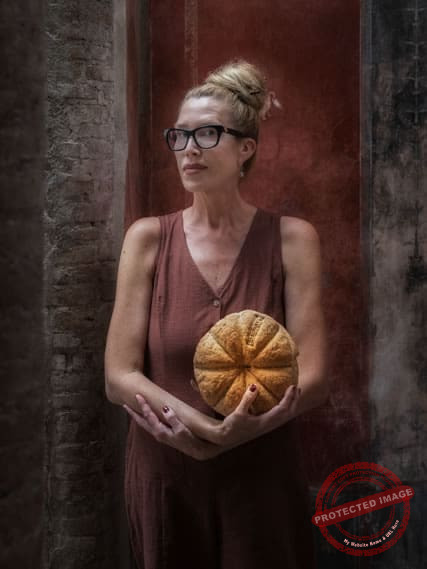
Farrell Monaco is an award-winning Classical archaeologist and food-writer whose research centers on food, food preparation, and bread in the Roman Mediterranean. She writes regularly on the role of food and food preparation in Roman daily life on her site, Tavola Mediterranea, and publishes in both English and Italian. Farrell has also written exclusively for Atlas Obscura and BBC Travel. Her work has been featured prominently by National Geographic, Popular Science, The Atlantic, the BBC, The Guardian, The Telegraph, The Economist, Esquire Magazine, SAPIENS Magazine, Saveur Magazine and Milk Street.

May 27
#OSK2026 😊
#Food #Friends #Pompeii #Cooking
...
May 26
“Varro also assures us that rotary querns have been found at Bolsena;
and we find in records of miraculous occurrences that some querns have even moved of their own accord.
Nowhere are more serviceable millstones to be found than in Italy, for
here they are proper stones and not lumps of rock. In certain provinces,
however, they are not found at all. Some stones of this kind are quite soft and can be smoothed also with a whetstone, so that from a distance they may be mistaken for serpentine. No other stones are more durable than millstones; for, as with wood, it is characteristic of stones of one sort or another to be unable to stand
rain, sun or wintry weather. Some are affected even by the moon, while others
acquire a patina in course of time or lose their white colour when treated with oil.”
- Pliny, Natural History, 36.29-30
#Italy #Bread #Pompeii #Ostia #Herculaneum
...
May 26
“Varro also assures us that rotary querns have been found at Bolsena; a
and we find in records of miraculous occurrences that some querns have even moved of their own accord.
Nowhere are more serviceable millstones to be found than in Italy, for
here they are proper stones and not lumps of rock. In certain provinces,
however, they are not found at all. Some stones of this kind are quite soft and can be smoothed also with a whetstone, so that from a distance they may be mistaken for serpentine. No other stones are more durable than millstones; for, as with wood, it is characteristic of stones of one sort or another to be unable to stand
rain, sun or wintry weather. Some are affected even by the moon, while others
acquire a patina in course of time or lose their white colour when treated with oil.”
- Pliny, Natural History, 36.29-30
#Italy #Bread #Pompeii #Ostia #Herculaneum
...
May 25
What a beautiful group of people we have this year. ❤️
#Pompeii #masterclass #archaeology #food #cooking
...
May 25
Two stories beneath the surface of the modern Campanian town of Boscoreale sits the stunning remains of a villa rustica: a Roman rural villa that doubled as a working farm, cultivating grain, grapes, olives, and other agricultural crops to process into food, oil and wine, or to sell, processed and unprocessed, in the nearby towns of Pompeii and Herculaneum. Far from being working country homes, villae rusticae formed an integral part of the Roman agricultural economy, combining domestic life, food production, trade, and labour within a single complex. These estates fed cities, supported local markets, and connected the countryside to the wider commercial networks of the Roman world.
‘Villa Regina’, as it is now called, offers an extraordinary glimpse into this agricultural landscape frozen in time by the eruption of Mount Vesuvius in 79 AD. Judging by the plan of the entire complex, as displayed inside the museum of the Antiquarium of Boscoreale, we become aware of how large the actual Villa once was and how much of it likely still exists beneath the modern apartment buildings surround the archaeological site. This is one of the remarkable places we will be visiting with our group this week as part of The Old School Kitchen – Culinaria Pompeiana annual master class, where we continue exploring the archaeology, history, and food culture of ancient Campania through the places where it was lived, produced, and shared. If you’re interested in following along, be sure to follow this account and join our newsletter! Link in bio or click here: https://tavolamediterranea.com
#archaeology #Food #Pompeii #Agriculture #MasterClass
...
May 24
Raffaele and I are beyond excited that our 2026 master class, The Old School Kitchen – Culinaria Pompeiana, officially begins today! This marks the second time we’ve held this week-long immersive experience in Pompei, and we are thrilled to welcome our international participants as we explore the food culture of Ancient Rome: from bakeries, vineyards, kitchens, and markets to the remarkable remnants of these traditions that still survive in modern Italian food and cooking practices today.
Over the next week, we’ll be visiting archaeological sites, meeting with specialists, tasting regional foods, cooking Roman meals, and examining the spaces, implements, and technologies that the ancient Romans used to produce food for domestic, commercial, and religious consumption. From mills and ovens to sacrificial cakes and ancient agricultural estates, we’ll be tracing the extraordinary continuity between the ancient and modern Mediterranean table.
If you’d like to follow along with us on this journey through history, archaeology, and food culture, be sure to share this post, follow this account, and sign up for our newsletter!
Link in bio or visit: https://tavolamediterranea.com
#Pompeii #MasterClass #Archaeology #Food #Bread
...
May 23
It was a real pleasure to finally meet Paolo Giulierini in person yesterday at Università Federico II – Reggia di Portici. As former director of the Museo Archeologico Nazionale di Napoli (MANN) (and now Director of the MAEC Cortona), Paolo transformed the Museo Archeologico Nazionale di Napoli from a traditional archaeological museum into one of the most internationally visible and culturally active museums in Europe during his tenure. Paolo was also the person who originally authorized my research permit several years ago to study the extraordinary carbonised breads held in the MANN laboratories.
That opportunity became an important part of my ongoing work on Roman bread and food archaeology, so it was especially meaningful to meet face to face after all these years. A wonderful moment of connection, conversation, and shared passion for the ancient Mediterranean at the beautiful Reggia di Portici. 🙏
#Napoli #Pane #Museo #Università #cultura
...
May 22
Today, Raffaele and I had the privilege of visiting the magnificent Università degli Studi di Napoli Federico II campus at the historic Reggia di Portici in Ercolano, where we warmly accompanied by Professors Mariangela Bianco and Marco Bottigliero. They guided us through the Department of Mediterranean Gastronomic Sciences, introducing us to the extraordinary projects currently underway by the students: work that beautifully bridges food, science, history, sustainability, and culture. We also visited the library, whose atmosphere and scent of old books nearly made my knees buckle… one of those rare spaces where scholarship feels almost sacred. 😍
The Federico II program in Scienze Gastronomiche Mediterranee is especially known for its interdisciplinary approach to food studies, combining agricultural science, food technology, history, communication, nutrition, and Mediterranean culinary heritage within one of the most historically significant academic settings in southern Italy. Housed within the Bourbon-era Reggia di Portici, the program reflects a remarkable union of historical legacy and forward-thinking research into the future of food cultivation and culture.
Thank you for an incredible day, Marco and Mariangela!
#Ercolano #federicoii #gastronomy #food #italy
...
May 21
A heartfelt thank you to Kendall Vanderslice for welcoming me into the final days of her Eucharist Pilgrimage through Greece and Rome! I joined the group in Orvieto yesterday at the beautiful Altarocca Wine Resort, where I had the pleasure of presenting on the relationship between Roman breads and sacrificial cakes and the earliest forms of Eucharistic bread forms. It was such a joy to finally spend time with Kendall and hear more about her incredible and groundbreaking work, and Katie of Life Beyond The Room, whose warmth and generosity made the experience all the more memorable.
What stayed with me most was the reminder that women coming together to support one another is only half the gift. The other half is learning from one another, sharing knowledge and experience freely, and celebrating the fullness of who we are: as writers, makers, bakers, and human beings. Grateful for the conversations, the hospitality, and the sense of community that emerged around the table!
#bread #baking #eucharist #italy #women
...
Email: [email protected]
Ph: 310-596-2424 (USA) | 020 3239 8691 (UK)

I might be late to the game here but have more details been announced yet?? I will be there!
Hi Emilie! The Walters should have info on their site posted soon!
!!! I love the Walters! This is right down the street from my office. I’ve been wanting to make Roman Bread for a while, I’ll definitely be there, and probably bring a bunch of other Roman history enthusiasts 🙂
See you there, Tim! – Farrell