Nothing Found
It seems that we can’t find what you’re looking for. Perhaps searching can help.
About the author:
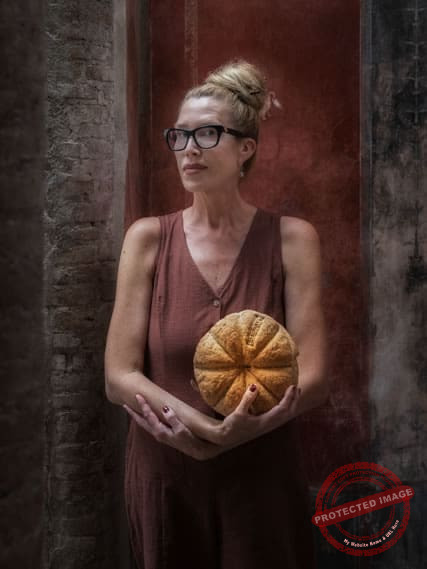
Farrell Monaco is an award-winning Classical archaeologist and food-writer whose research centers on food, food preparation, and bread in the Roman Mediterranean. She writes regularly on the role of food and food preparation in Roman daily life on her site, Tavola Mediterranea, and publishes in both English and Italian. Farrell has also written exclusively for Atlas Obscura and BBC Travel. Her work has been featured prominently by National Geographic, Popular Science, The Atlantic, the BBC, The Guardian, The Telegraph, The Economist, Esquire Magazine, SAPIENS Magazine, Saveur Magazine and Milk Street.

May 17
FAO visit afterthought: Emma and Simona are elegantly normal-height humans. And then there’s me. 😂 Guess which one of us will NEVER be getting a call from the Rockettes? (Hint: it’s the one blocking the signage.)🦒🤣
.
#tallgirlproblems #FAO #rockettes
...
May 17
This week I had the privilege of visiting FAO MuNe in Rome, guided by the wonderful Emma Gilardi and Simona Vani. MuNe is FAO’s new museum of nutrition and food culture, and it’s incredible!
Accessible, visually stunning, and genuinely thought-provoking… I’m still thinking about the Uzbek tandyr oven and the Romanesque agricultural calendar days later. 😍
If you’re in Rome, put this on your list. Huge congratulations to everyone who brought it to life! 🙌
#FAO #UN #Rome #Food #Museum
...
May 14
Nothing like having a big old cry in the middle of the Vatican Museums. This week I finally came across something I hadn’t yet seen in person: a sculpture fragment from a 3rd century sarcophagus discovered on the Appia Antica, depicting the interior of a Roman bakery, and crucially, the horses labouring within it.
It immediately brought to mind the chapter in Apuleius’ The Golden Ass where Lucius, transformed into a donkey, is put to work in a bakery. The passage has always struck me for its dual perspective: Lucius describes both his own experience at the mill and the poor conditions of the enslaved people working alongside him. I’ve always read it as Apuleius quietly asking the reader to reckon with cruelty, whether toward animals or humans.
Standing in front of such beautifully sculpted evidence of that world makes the text feel very immediate. Maybe Apuleius also stopped to talk to the horses in the street. I like to think he did.
(Translation of The Golden Asse: Adlington (1566)).
#Roman #Bakery #Horses #literature #Archaeology
...
May 10
A walk along the Tiber river in Rome doesn’t just burn off last night’s amatriciana, it reveals some of the river’s grain milling history and archaeology of bread production… right on the footpath! Along the river beneath Ponte Sublicio, a few reminders still survive of one of Rome’s oldest industries: grain milling. Floating mills operated on the river from at least the 6th century AD, when the general Belisarius famously turned to the Tiber for water power after Rome’s aqueducts were cut during the Gothic siege of 537 AD. For centuries afterward, the riverbanks were lined with mills that ground grain into flour for the city’s daily bread supply. The large basalt millstones resting today beside the footpath are likely later examples, probably dating between the 18th and 19th centuries, when dozens of floating mills still worked the river before the great embankment walls transformed the Tiber in the late 1800s. Worn by water, grain, and time, these millstones tell the story of the labour that once fed Rome its daily bread. 😍
.
.
#Rome #Bread #Engineering #Archaeology #Food
...
May 9
When in Naples… 😋
.
.
#pastry #naples #napoli #pasticceria #foodgasm
...
May 8
What a day it was in Pompei! 20,000 of us gathered in Piazza Bartolo Longo early this morning to wait for Pope Leo to arrive by helicopter. On the first anniversary of his appointment as Pope, he delivered a long mass today addressing the urgent need for peace and love, and the end to fratricidal hatred in this world. “No more wars, we cannot resign ourselves to images of death”. The mass was then followed by the spine-tingling sound of the recitation of The Supplica (a lengthy prayer written in 1883 by Saint Bartolo Longo) by all in attendance, echoing through the streets of the town. Powerful! ❤️
.
.
#Pope #Leo #Pompei #papá #supplica
...
May 7
Good morning, Rome! From focaccia to filone, you always rise to the occasion. 😍 Let’s do this!
.
.
#bread #rome #iloveyou #breakfast #letsdothis
...
May 5
Hello, beauteous England! ❤️
.
.
#england #flying #britishairways #home #sky
...
Apr 26
Behind every loaf of bread is a team of workers: farmers who cultivate the grain, millers who grind it, bakers who shape and fire it, and the many hands that carry it from field to table. In the ancient world, this chain of labour was visible, shared, and woven into daily life. Bread was never just food: It was the product of collective effort, skill, and time. Remembering that labour reminds us that every loaf, past or present, is an expression of human partnership and connection. Thank you to @__al_vecchio_mulino__ for our new connection and for working with us to carry forward one of the oldest labours in human history: the making of bread. I cannot get enough of it and neither can any of you! We are kindred spirits! 🙏
.
.
#bread #roman #work #team #history
...
Email: [email protected]
Ph: 310-596-2424 (USA) | 020 3239 8691 (UK)