Nothing Found
It seems that we can’t find what you’re looking for. Perhaps searching can help.
About the author:
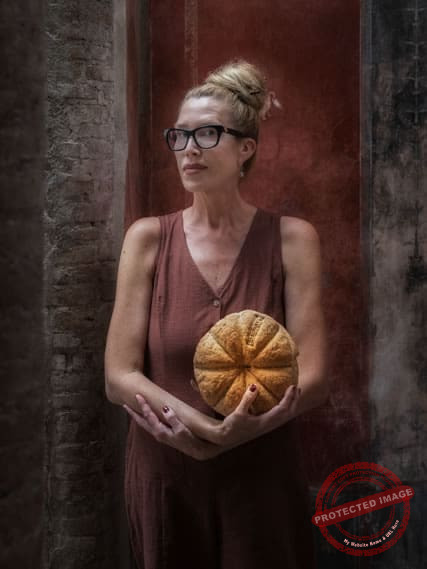
Farrell Monaco is an award-winning Classical archaeologist and food-writer whose research centers on food, food preparation, and bread in the Roman Mediterranean. She writes regularly on the role of food and food preparation in Roman daily life on her site, Tavola Mediterranea, and publishes in both English and Italian. Farrell has also written exclusively for Atlas Obscura and BBC Travel. Her work has been featured prominently by National Geographic, Popular Science, The Atlantic, the BBC, The Guardian, The Telegraph, The Economist, Esquire Magazine, SAPIENS Magazine, Saveur Magazine and Milk Street.

Jun 13
I recently experienced the worst travel day of my life and, no, it didn’t involve United Airlines, so I suppose it could’ve been worse!
It started at Rome Fiumicino and rapidly escalated into what can only be described as Dante’s nine circles of Hell with passport control. “Abandon all hope, ye who fly here.” Delayed flights. Broken trains between terminals at Heathrow. Turbulence over London. Somewhere along the way, my suitcases decided they wanted to stay in Europe rather than come home with me.
By the time I spilled into Terminal 5, a complete hot mess, all I wanted was a decent book, a cup of tea, and a quiet corner. My mission? To find ‘Roman Empire by Train – A Travel Journal’, at WHSmith. No luck. 😭
Rather than adding “passenger outburst resulting in arrest” to my list of travel mishaps, I downloaded the Kindle edition and settled in for the flight home. The book itself (written by James McNally) was a delight, bringing back wonderful memories of the TV series and my time filming with Professor Alice Roberts in Turin, but the real surprise was the foreword, written by Alice herself. ☺️
Imagine my delight to discover that Alice had included a very kind mention of me following one of our catch-ups in London last year. In an instant, the delayed flights, broken trains, lost bags, bouncy planes, and bad travel hair simply melted away. 🥰
I’m incredibly fortunate and grateful, not only to have worked with Alice, but to count her as a friend. She is one of the great trailblazers of our field and an inspiration to women in archaeology, history, and academia everywhere.
Author. Academic. Broadcaster. Television presenter. Tireless advocate for archaeology and science. Honestly, I have no idea when she sleeps! Somehow she’s constantly raising the bar while making the rest of us wonder whether we’ve really had such a busy week after all. 😅
Alice shows us what passion, curiosity, conviction, kindness, and hard work can achieve. Thank you, Alice, for continuing to inspire so many of us to aim a little higher, dream a little bigger, and work a little harder. 💪❤️ 😃
#books #archaeology #women #academia #TV
...
Jun 13
Thank you to all of my #Goldbelly buyers who waited patiently for their orders while I was away in Italy. 🙏 I’m back at my ovens... Let the bread times roll!! 😍 Orders can be placed using the link in bio 👆 or by clicking here: https://www.goldbelly.com/restaurants/pistrinum-by-tavola-mediterranea
.
.
#bread #order #online #delivery
...
Jun 11
There’s always that one kid in class. You know the one: they did their homework, read the assigned texts, went the extra mile, and somehow got the best grades while the rest of us were lurking outside the punk rock doors of our high school smoking cigarettes and making questionable life choices…
Well, at this year’s Old School Kitchen master class, we didn’t have one of those students… we had two!
A huge thank you to Megan and Karen for pursuing excellence and for caring so deeply about the ancient texts, art, and archaeology, asking not just “what did the Romans make?” but “what can we make using the evidence alone?”
Their recreation of Virgil’s and Pompeii’s ‘adorea liba’ absolutely knocked it out of the park. Good enough for the gods, but even better for the rest of us, because we got to eat them. 😋
This is experimental archaeology at its best, folks: curiosity, scholarship, collaboration, and a delicious reward. A+ to Megan and Karen. You can collect your Toys-R-Us gift cards after class. 😉 😊
.
.
#pompeii #food #art #archaeology #cooking
...
Jun 6
One of the unexpected lessons from this year’s The Old School Kitchen – Culinaria Pompeiana master class was that the Romans practised what we might call ‘zero-food waste’, not because it was fashionable but because food had value and famine was never far from memory.
During the class, we prepared Columella’s ‘defrutum’: a rich reduction of grape must flavoured with fennel and fenugreek. Rather than discarding the grape and herb pulp, Karen and Victoria followed the Roman mindset and transformed it into Cato’s grape must cakes the very next day. Nothing wasted. Everything given a second life.
This approach would have been familiar to any Roman farmer or cook. For the Romans, the use of so-called ‘food waste’ was not merely economy, it was survival. For example: Cato and Pliny describe preserving and drying fruit that would last through the year, teaching us that every ingredient represented the labour of people, the productivity of the land, and the uncertainty of the next harvest. During our week in Pompeii, we tried to step into that ancient mindset, discovering that some of the most memorable dishes came not from extravagance, but from ingenuity and respect for the ingredients at hand.
These grape must cakes became one of the unexpected highlights of our Pompeian master class. More to follow!
#food #waste #pompeii #roman #cooking
...
Jun 4
Our group made a bread offering at a Marian shrine up at the caldera of Mount Vesuvius. A beautiful location for a shrine, if you ask me, and a fitting place to make an offering too! Yes we offered taralli napoletani… This too is fitting, and beautiful. 🙏 💪 🥯 🌋
.
.
#vesuvius #shrine #offer #bread #mary
...
Jun 3
Modern Ercolano rises directly above the ancient city of Herculaneum, creating one of the most remarkable layers of history anywhere in the world. Beneath the streets, apartment buildings and churches of the modern town lie the extraordinarily preserved remains of the Roman city, entombed beneath 15–20 metres of volcanic material during the eruption of Mount Vesuvius in AD 79. Yet what visitors see today is only part of the story:
Archaeologists estimate that roughly 75% of ancient Herculaneum remains buried beneath the modern town, leaving much of the city’s forum, temples, streets, and houses still hidden from view. In this photograph, the relationship is laid bare: the modern city in the foreground, ancient Herculaneum concealed below, and Vesuvius itself standing watch in the background: the very force that destroyed one city and, paradoxically, preserved most of it for nearly two millennia.
.
.
#herculaneum #vesuvius #volcano #archaeology #roman
...
Jun 2
Scenes from the Republic. ❤️ Viva La Repubblica! 🇮🇹
.
.
#FestadellaRepubblica #Italia #Napoli #musica #Giungo2
...
Jun 2
After a magnitude 6.2 earthquake to the south of us in Calabria last night (it was felt here in Campania!!), we are reminded of regular seismic and volcanic activity that is a risk of daily life here in southern Italy, since time immemorial. Here’s another reminder: steam coming out of the caldera of Vesuvius when we hiked it three days ago! The volcano may be dormant but it is still active. 🌋
.
.
#pompeii #vesuvius #earthquake #italy #earth
...
Jun 1
No trip to Pompei, exploring the culture and daily lives of the ancient Romans, would be complete without acknowledging the women who occupied some of its most complex and enticing social spaces. This weekend, we were treated to a beautiful performance at Caupona by Burlesque Cabaret Napoli, whose ‘Notte delle Lupe’ brought to life themes of femininity, beauty, desire, and female power drawn from both mythology and history.
The title Notte delle Lupe draws on the ancient Roman term ‘lupa’ (‘she-wolf’), a word that referred to women working in a city’s erotic sphere, while also evoking the powerful symbolism of the she-wolf in Roman culture. After all, it was a lupa (the legendary she-wolf of Rome) who nurtured and protected Romulus and Remus, forever linking the image of the lupa with themes of strength, power, and the very origins of the Eternal City of Rome.
Far more than a simple portrayal of the past, the performance celebrated the power and beauty these women had, while living in a world that could be both restrictive and dangerous. Through dance, costume, and music, the dancers evoked the enduring spirit of women whose lives have often been sensationalized, yet whose presence was always woven into the fabric of ancient society.
Thank you to Burlesque Cabaret Napoli for a thoughtful and captivating evening that reminded us that the lives of ancient Romans are not only found in ruins and artefacts, but also in music, dance, and portrayal of the lupe who once lived among them. ❤️ 💪 🐺
.
.
#pompeii #women #dance #rome #history
...
Email: [email protected]
Ph: 310-596-2424 (USA) | 020 3239 8691 (UK)